
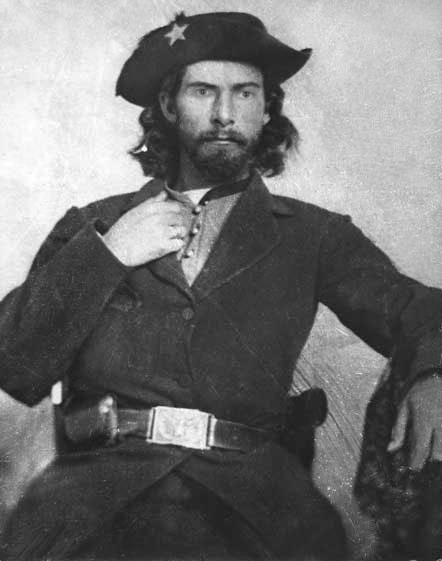
William T. “Bloody Bill” Anderson was a Southern-sympathizing bushwhacker born in Missouri and raised in Kansas. By the time of his death in 1864, Anderson had become one of the most sought-after men in Missouri and had left a trail of blood and hatred across the western and central portions of the state. According to Larry Wood in his book I Am a Guerrilla: The Civil War Story of “Bloody Bill” Anderson, in the 1850s Anderson was considered by his Missouri classmates as “better behaved than average” and by his future Kansas neighbors as a “steady, hard working young man.”[1]
So what happened to young Bill Anderson that earned him the nickname “Bloody Bill” and even the respect and adoration of a young Jesse James? How did the tactics Anderson used fit into the broader history of guerrilla warfare, and to what extent can his destructive methods be compared with the “total war” associated with Union General William T. Sherman?
By the time Anderson was in his early twenties, the Civil War had begun. In 1862 Anderson’s father, William C. Anderson, was implicated along with his sons in a dispute over horse theft involving A. I. Baker, a former family friend and Union sympathizer. When the elder Anderson sought vengeance, he confronted Baker and was killed.
After his father’s funeral, Bill Anderson sought out Baker. A shootout followed at Baker’s home, and Baker eventually took refuge in the cellar. Anderson and his companions set the building on fire, and Baker died in the blaze. Anderson and his men then returned toward Missouri, engaging in robbery and violence along the way.
In August 1863, Union authorities arrested several female relatives of known guerrillas, including Anderson’s sisters, and confined them in a brick building on Grand Avenue in Kansas City. The building collapsed on August 13. Anderson’s sister Josephine was killed, while other members of his family were seriously injured. The exact cause of the collapse became the subject of controversy, but Anderson, Quantrill, and many of their followers believed Union authorities were responsible.
Anderson had already endured considerable family tragedy. His mother had died after being struck by lightning, his father had been killed, and his brother had also died. After the death of Josephine and the injuries suffered by his other sisters, Wood describes a dramatic change in Anderson. Richard S. Brownlee similarly characterized Anderson as becoming a “homicidal maniac.”[2]
Anderson continued his violent campaign across Missouri, killing Union soldiers and Unionist civilians. Among the guerrillas associated with him was Archie Clement, who became one of Anderson’s most trusted lieutenants. Anderson’s band became notorious for the mutilation and scalping of some of its victims. By the final months of his life, Anderson appears to have developed an almost fatalistic attitude toward his own survival. John N. Edwards, an early chronicler of the Missouri guerrillas, attributed to Anderson the statement, “If I cared for my life I would have lost it long ago; wanting to lose it I cannot throw it away.”[3]
“Bloody Bill” had earned his nickname. By 1864, his command had become one of the most feared guerrilla bands operating in Missouri.
Anderson and the bushwhackers employed methods characteristic of irregular warfare rather than conventional nineteenth-century battlefield tactics. They relied on mobility, surprise, ambush, intimate knowledge of the countryside, sympathetic civilians, and the ability to disappear back into the population. Guerrillas sometimes wore captured Union uniforms or other clothing that allowed them to approach soldiers or civilians without immediately revealing their identity.
These methods have similarities to tactics used in later guerrilla and insurgent conflicts, but direct comparisons with modern terrorism should be made cautiously. Missouri’s bushwhackers operated within the particular political, military, and social environment of the Civil War border region. Whether particular guerrilla actions should be described as military operations, outlawry, terrorism, or some combination of the three depends on the action being examined and the definition being used.
Anderson’s methods also invite a limited comparison with the destructive warfare associated with William T. Sherman. Both exploited local resources and recognized that railroads, supplies, communications, and civilian support could contribute directly to an enemy’s ability to wage war. The purposes and methods of Sherman’s armies and Anderson’s guerrillas, however, were substantially different. Sherman operated as the commander of large organized armies under federal authority, while Anderson commanded a small irregular force whose relationship with Confederate military authority was often uncertain and inconsistent.
During Confederate General Sterling Price’s raid into Missouri in 1864, however, Anderson did receive direct orders from Price’s headquarters. On October 11, 1864, Price’s command issued a special order directing Anderson to proceed north of the Missouri River and “permanently destroy the North Missouri Railroad, going as far east as practicable.”[4] The order illustrates that, at least during this stage of Price’s campaign, Confederate authorities were willing to employ Anderson and his men against an important Union transportation and communications network.
That similarity to conventional military operations should not obscure the increasingly brutal character of Anderson’s campaign. His band killed prisoners and civilians, committed robberies, and mutilated some of the dead. Loyalty alone did not always determine who became a victim. By the autumn of 1864, the distinction between guerrilla warfare, personal vengeance, and outright criminality could become extremely difficult to draw.
William T. “Bloody Bill” Anderson ultimately met the fate of many of the guerrillas who fought in Missouri. On October 26, 1864, Missouri State Militia troops under Lieutenant Colonel Samuel P. Cox encountered Anderson’s command near Albany in Ray County. Anderson was killed during the fight. His body was taken to Richmond, Missouri, where it was photographed and placed on public display.
The relief with which many Missourians greeted his death is reflected in Larry Wood’s title for the final chapter of his biography of Anderson: “One Devil Less in the World.”[5] Anderson had become a symbol of the extraordinary violence that characterized Missouri’s guerrilla war.
William T. “Bloody Bill” Anderson began life as a Missouri boy remembered by acquaintances as relatively ordinary. The violence of the Kansas-Missouri border, personal feuds, the deaths of family members, and the Civil War transformed the course of his life. By 1864, he had become one of the most feared guerrilla leaders in Missouri. His story provides a stark example of how quickly conventional warfare, irregular warfare, personal vengeance, and criminal violence could merge along the Civil War border.
- Larry Wood, I Am a Guerrilla: The Civil War Story of “Bloody Bill” Anderson (Austin, TX: Eakin Press, 2003), chap. 1, “My Native State of Missouri.” The chapter begins on p. 1. ↩
- Larry Wood, I Am a Guerrilla: The Civil War Story of “Bloody Bill” Anderson (Austin, TX: Eakin Press, 2003), chaps. 5–6, “They Murdered My Sister” and “I Have Glutted My Vengeance,” 29–48; Richard S. Brownlee, Gray Ghosts of the Confederacy: Guerrilla Warfare in the West, 1861–1865 (Baton Rouge: Louisiana State University Press, 1958). Brownlee’s characterization of Anderson as a “homicidal maniac” is also quoted in Lawrence O. Christensen et al., eds., Dictionary of Missouri Biography (Columbia: University of Missouri Press, 1999). ↩
- John N. Edwards, Noted Guerrillas, or the Warfare of the Border (St. Louis: Bryan, Brand & Co., 1877), 326. ↩
- Special Order, Headquarters Army of Missouri, Boonville, Missouri, October 11, 1864, in The War of the Rebellion: A Compilation of the Official Records of the Union and Confederate Armies, ser. 1, vol. 41, pt. 4 (Washington, DC: Government Printing Office, 1893), 354. The order stated: “Captain Anderson, with his command, will at once proceed to the north side of the Missouri River and permanently destroy the North Missouri Railroad, going as far east as practicable. He will report his operations at least every two days.” ↩
- Wood, I Am a Guerrilla, chap. 14, “One Devil Less in the World,” 136–42. This wording is used here from Wood’s chapter title rather than attributed as a direct quotation from an unidentified contemporary newspaper. ↩