
After the beginning of the Civil War, tensions in Missouri rapidly increased as both Unionists and Southern sympathizers worried about control of the state and its military resources. In April 1861, pro-Southern forces seized the federal arsenal at Liberty, Missouri, taking hundreds of weapons and ammunition. The arsenal in St. Louis was far more important, holding one of the largest stores of military arms in the slave states, including tens of thousands of rifles and muskets.
Fearing that pro-Confederate forces might attempt to seize the St. Louis Arsenal as well, Congressman Frank P. Blair Jr. and Captain Nathaniel Lyon worked to secure the installation and organize loyal forces in the city. Many of these Union volunteers came from St. Louis’s large German immigrant population, which was strongly opposed to secession. Lyon also quietly arranged for much of the arsenal’s stockpile of weapons and ammunition to be transferred across the Mississippi River to Illinois, placing them beyond the reach of Missouri secessionists.
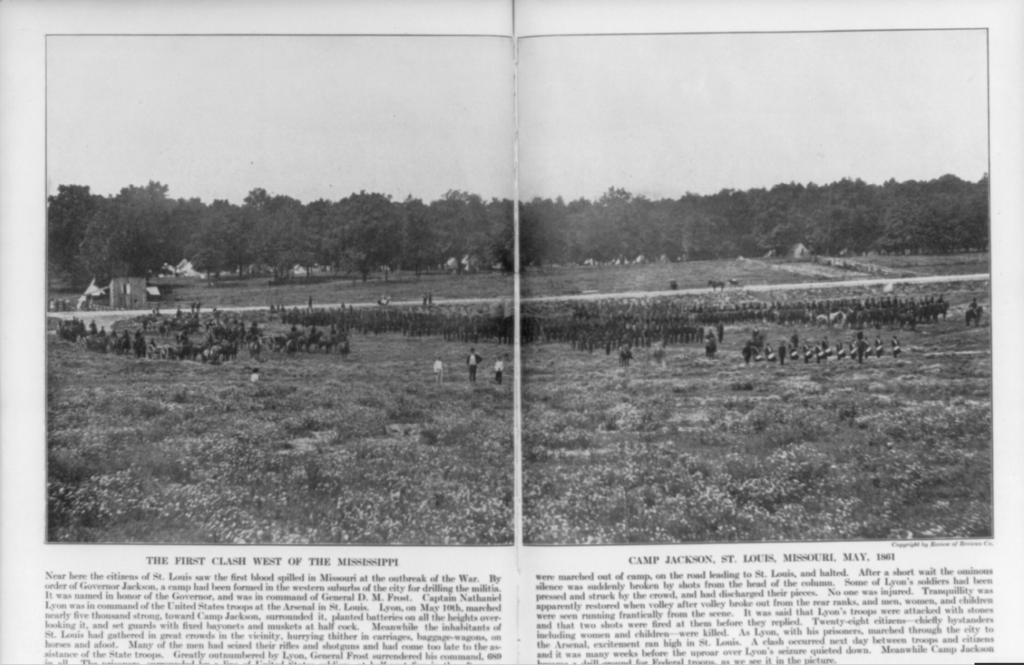
Governor Claiborne Fox Jackson, who publicly continued to present Missouri as neutral while increasingly moving toward the Southern cause, ordered the state’s militia districts to assemble for their annual training. In St. Louis, Brigadier General Daniel M. Frost established an encampment at Lindell Grove that became known as Camp Jackson.
Frost openly favored Missouri’s secession and had previously urged Jackson to prepare for a possible attack on the St. Louis Arsenal. His camp soon received four pieces of artillery that had originally been seized by Confederate authorities from the federal arsenal at Baton Rouge, Louisiana, and sent north to Missouri. Their arrival strengthened Union suspicions that Camp Jackson represented a direct threat to federal control of St. Louis.
On May 10, 1861, Lyon moved against the camp. Federal troops surrounded Camp Jackson and compelled Frost and his Missouri militiamen to surrender. Lyon then marched the prisoners through the streets of St. Louis toward the arsenal under guard by Union troops, including many members of the German Home Guard.
The sight of Missouri militiamen being marched through the city by federal troops angered many residents. Crowds gathered along the route, shouting insults and throwing objects at the soldiers. Tensions between St. Louis’s German Unionists and pro-Southern residents, already heightened by political and ethnic divisions, quickly boiled over.
Gunfire eventually erupted. Union soldiers fired into the crowd, killing civilians and touching off widespread violence. Contemporary accounts and later sources differ somewhat on the precise casualties, but at least twenty-eight civilians were killed during the violence associated with Camp Jackson. Rioting and disorder continued in St. Louis for two days.
The Camp Jackson Affair dramatically changed Missouri’s political situation. Until that point, many Missourians had attempted to remain somewhere between outright secession and unconditional support for the Union. The bloodshed in St. Louis made that increasingly difficult. Questions of Union, secession, slavery, states’ rights, federal authority, and ethnic tension were now intertwined with the immediate reality of armed violence within the state.
The incident also strengthened Governor Jackson’s position in calling for greater military preparations. In the aftermath of Camp Jackson, the Missouri legislature passed a military bill reorganizing the state’s forces and creating the Missouri State Guard. Former governor Sterling Price, who had previously been a conditional Unionist and had worked for compromise, was appointed major general in command.
Camp Jackson proved especially important in Price’s political transformation. Outraged by the events in St. Louis, he offered his services to Jackson and moved increasingly toward the pro-Southern position. At the same time, Major General William S. Harney, commander of the federal Department of the West, attempted to prevent further bloodshed by reaching an agreement with Price. Under the Price-Harney Agreement, federal troops would largely remain in St. Louis while Price’s state forces attempted to maintain order elsewhere in Missouri.
The arrangement did not last. Lyon and Blair believed it gave Jackson and the Missouri State Guard time to organize and strengthen their position. Harney was relieved of command on May 30, and Lyon, newly promoted to brigadier general of volunteers, emerged as the dominant Union military commander in Missouri.
On June 11, 1861, Governor Jackson and Sterling Price met with Lyon and Frank P. Blair Jr. at the Planters’ House Hotel in St. Louis in a final attempt to reach an agreement. The conference lasted several hours, but the two sides could not reconcile their positions. Jackson wanted federal military activity restricted within Missouri, while Lyon refused to surrender the federal government’s authority to operate within the state.
The meeting ended abruptly. Lyon made it clear that he would fight rather than accept restrictions on federal authority in Missouri. Jackson and Price returned to Jefferson City knowing that armed conflict was now imminent.
Within days, Lyon moved up the Missouri River and occupied Jefferson City, forcing Jackson and the pro-Southern state government to retreat. Federal and Missouri State Guard forces soon clashed at Boonville, beginning a campaign that would carry the fighting across the state and eventually culminate that summer at Wilson’s Creek.
The Camp Jackson Affair therefore became far more than a confrontation between federal troops and Missouri militiamen. It helped destroy the fragile political middle ground that had existed in Missouri during the opening months of the Civil War. For many Missourians, the events of May 10, 1861, made neutrality increasingly impossible and helped light the fuse for the conflict that would engulf the state for the next four years.
SOURCES
- Bradbury, John. “Battle of Wilson’s Creek.” Missouri Encyclopedia. State Historical Society of Missouri. Updated September 16, 2021. https://missouriencyclopedia.org/events/battle-wilsons-creek.
- Phillips, Christopher. “Claiborne Fox Jackson (1806–1862).” Missouri Encyclopedia. State Historical Society of Missouri. https://missouriencyclopedia.org/people/jackson-claiborne-fox.
- Phillips, Christopher. “Daniel Marsh Frost (1823–1900).” Missouri Encyclopedia. State Historical Society of Missouri. April 13, 2020. https://missouriencyclopedia.org/people/frost-daniel-marsh.
- Rowe, Mary Ellen. “Sterling Price (1809–1867).” Missouri Encyclopedia. State Historical Society of Missouri. Updated September 23, 2021. https://missouriencyclopedia.org/people/price-sterling-1809-1867.
- The First Clash West of the Mississippi, Camp Jackson, St. Louis, Missouri, May 1861. 1911. Photograph. Library of Congress, Prints and Photographs Division. https://www.loc.gov/item/96505335/.
- United States War Department. The War of the Rebellion: A Compilation of the Official Records of the Union and Confederate Armies. Series I, vol. 3. Washington, DC: Government Printing Office, 1881.